This question is addressed in the article “Toward Super Resolution Reconstruction of Diffusion-Relaxation MRI Using Slice Excitation With Random Overlap (SERO)” by Felix Mortensen, Jakub Jurek, Jens Sjölund, Geraline Vis, Ronnie Wirestam, Malwina Molendowska, Andrzej Materka, and Filip Szczepankiewicz.
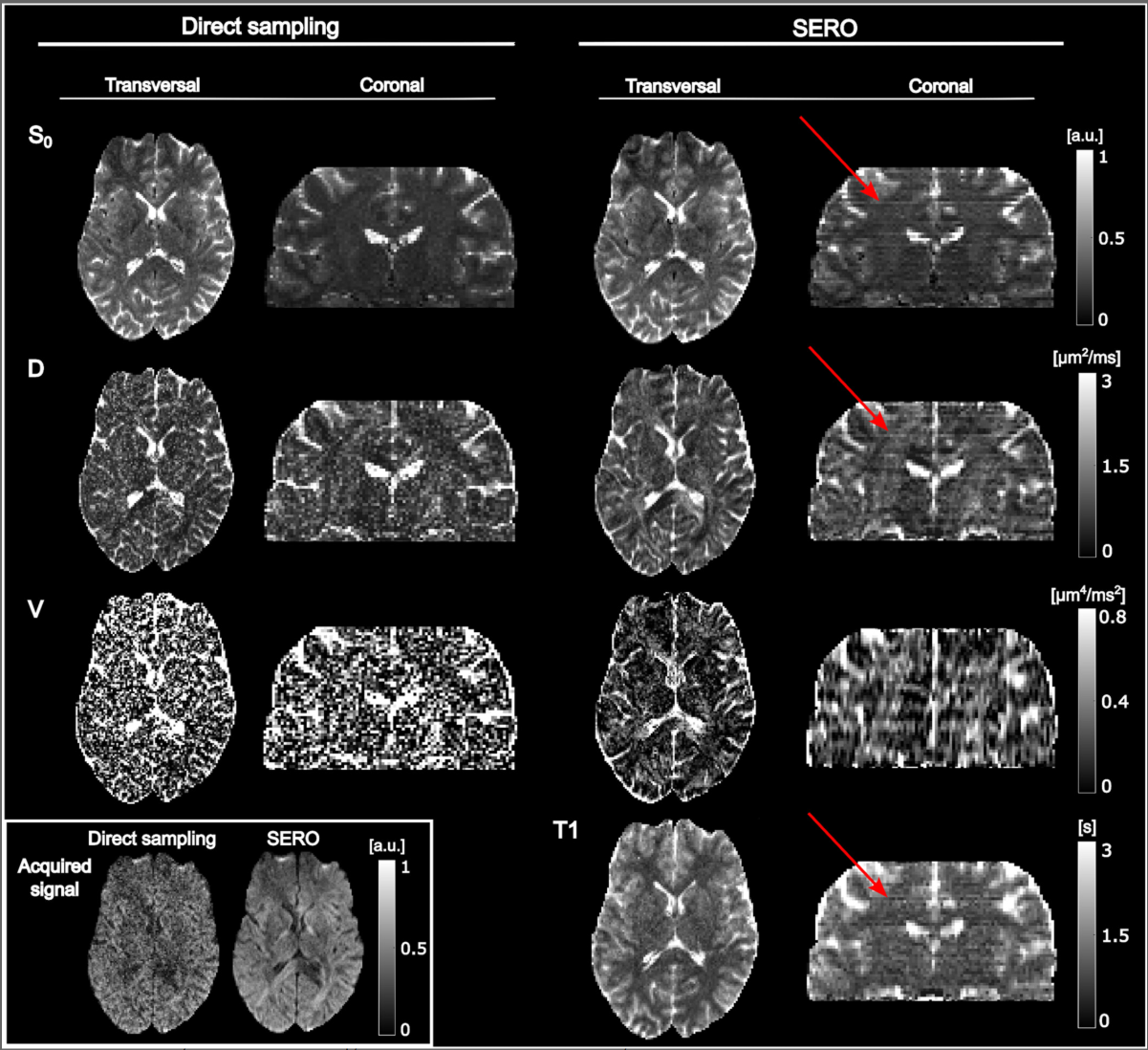
🔬 The publication discusses the challenge of obtaining a high-resolution image from multiple low-resolution images — a process known as super-resolution reconstruction.
📌 The proposed method involves rapid brain scanning to acquire as many as 1,000 slices with random positions and a thickness of 6 mm. These data are then combined using a mathematical model that reconstructs them into 40 slices with a thickness of 1.5 mm.
Moreover, each slice is reconstructed in four types of contrast, depending on:
• proton density,
• tissue T1 relaxation time,
• diffusivity,
• variance of water molecule diffusivity.
🧪 The study was conducted on brain images and represents an important step in the development of modern MRI techniques.
🤝 The article is the result of collaboration between our staff and a team of magnetic resonance physicists from Lund University in Sweden. Further research on this topic is currently ongoing at the Institute of Electronics.
✒️ We encourage you to read the full article:
Felix Mortensen, Jakub Jurek, Jens Sjölund, Geraline Vis, Ronnie Wirestam, Malwina Molendowska, Andrzej Materka, Filip Szczepankiewicz, "Toward Super-Resolution Reconstruction of Diffusion-Relaxation MRI Using Slice Excitation With Random Overlap (SERO)", Magnetic Resonance in Medicine, 2026; 0:1–14, https://doi.org/10.1002/mrm.70282